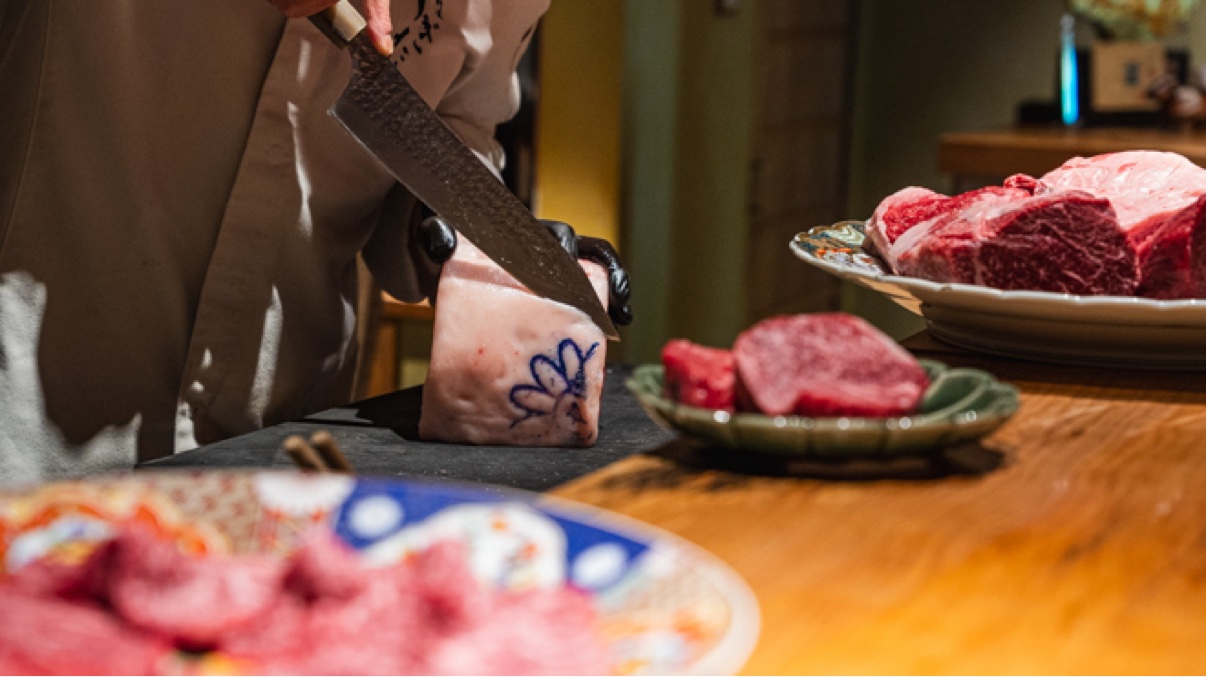
If you have ever looked at a menu outside Japan, you have probably seen the word “wagyu” everywhere — wagyu burgers, wagyu tacos, wagyu at every price point. And somewhere near the top of the menu, often in larger letters, sits “Kobe beef,” usually attached to the most expensive item.
It is natural to assume the two words describe the same thing, or that “Kobe” is simply the premium version of “wagyu.” In Japan, however, these words have precise and quite different meanings. Wagyu is a category of cattle. Kobe Beef is a certification given to beef. Between them sits a third name you may not know yet — Tajima — and understanding how the three fit together is the key to knowing what you are actually eating.
Here is the short version: all Kobe Beef is wagyu, but almost all wagyu is not Kobe Beef. To see why, we need to unpack each word in turn.
What “Wagyu” Actually Means
“Wagyu” (和牛) literally means “Japanese cattle.” It refers to four breeds native to Japan — Kuroge Washu (Japanese Black), Akage Washu (Japanese Brown), Nihon Tankaku (Japanese Shorthorn), and Mukaku Washu (Japanese Polled) — together with crosses between those breeds.
That is all the word tells you. Wagyu describes the cattle themselves: their breed and bloodline. It does not name a place, and it is not a quality grade or a brand certification. Wagyu cattle are raised all across Japan, and many regions have built their own famous beef brands on them. Two pieces of beef can both be genuine wagyu and yet come from different prefectures, different farms, and different bloodlines — and taste quite different as a result.
So when you see “wagyu” on a menu, you are learning something real but general: the beef comes from Japanese cattle genetics. You are not yet learning where that particular beef was raised, or whether it passed any specific brand’s standards.
And What About “Domestic Beef”? (Kokusan-gyu)
Japan has one more label that is often confused with wagyu: kokusan-gyu (国産牛), usually translated as “domestic beef.”
Kokusan-gyu is not about breed at all. It is a category based on where an animal was raised — specifically, it refers to cattle whose longest period of raising was in Japan. In other words, wagyu is a statement about genetics, while kokusan-gyu is a statement about geography.
This is why the two words are not interchangeable. Beef can be kokusan-gyu without being wagyu, if the animal was raised longest in Japan but does not belong to the four Japanese breeds or their crosses. And wagyu raised entirely outside Japan would not be kokusan-gyu. When you are trying to understand what is on your plate, always ask which question a label is answering: what breed is it? or where was it raised?
Tajima Cattle: The Foundation of Kobe Beef
Now we come to the name that connects wagyu to Kobe Beef: Tajima cattle (但馬牛, Tajima-gyu).
Tajima is a bloodline within the Kuroge Washu (Japanese Black) breed, raised in Hyogo Prefecture under strict conditions of lineage and production. The name “Tajima” refers to the living cattle — the animals themselves, born and raised in Hyogo, in a bloodline whose purity has been carefully preserved since the Edo period.
Tajima cattle are raised slowly, typically for around 30 to 32 months, and their bloodline is the foundation on which one of the world’s most famous beef brands is built. A calf is born and raised on a breeding farm, passes through a calf market at around eight or nine months old, and then spends roughly two years on a fattening farm, fed on roughage such as rice straw together with balanced compound feed. It is unhurried, unglamorous work — and it is exactly this long, careful raising that stands behind every certified cut.
But here is the point that surprises many people: even a genuine Tajima animal is not yet “Kobe Beef.” Tajima is the raw material. Kobe Beef is what a portion of that material may become — if it passes every test.
Kobe Beef: A Certification, Not a Breed
Kobe Beef (神戸ビーフ) is not a breed of cattle, and it is not simply beef from the city of Kobe. It is a name granted only to beef from Tajima cattle that meets a full set of strict standards — covering bloodline, production, processing, and meat quality.
Some of the key conditions:
- The beef must come from Tajima cattle born and raised in Hyogo Prefecture.
- It must be produced by designated producers, under the prescribed conditions within the prefecture, and processed at designated meat centers.
- It must come from a virgin heifer or a steer.
- It must meet standards for meat quality, including fat marbling, and for carcass weight.
Perhaps the most important detail is the timing. A living animal is never certified as Kobe Beef. Certification happens only after the animal has been processed, when the beef itself can be checked against every standard. If even one condition is not met, that beef cannot carry the name — no matter how good it looks or tastes.
The system is administered by the Kobe Beef Marketing & Distribution Promotion Association, founded in 1983 to define the brand and protect its credibility. It was created because, as the name became famous, imitations appeared and there was no clear, checkable definition of the real thing. So “Kobe Beef” is best understood as a certificate of origin and standards, stamped onto beef that has earned it — not a category of cattle, and not a synonym for wagyu.
Side by Side: Wagyu, Tajima, Kobe Beef
| Wagyu | Tajima | Kobe Beef | |
|---|---|---|---|
| What it refers to | A category of cattle breeds | A bloodline of living cattle | Certified beef |
| The name answers | “What breed is it?” | “Which bloodline, raised where?” | “Did this beef pass the standards?” |
| Scope | Four native Japanese breeds and their crosses, raised across Japan and abroad | Kuroge Washu bloodline raised in Hyogo Prefecture | Beef from Tajima cattle meeting all certification standards |
| Key point | A statement about genetics | The foundation of Kobe Beef | A statement about certification — granted after processing |
Think of it as three nested circles. Wagyu is the largest circle. Inside it sits the Tajima bloodline. And inside that, smaller still, is the beef that clears every hurdle and is certified as Kobe Beef.
“But It’s A5 — Isn’t That Kobe Beef?”
This is the most common misunderstanding of all. In Japan, A5 is the highest grade on the national beef grading scale. The grade evaluates several elements of meat quality, including fat marbling (measured as BMS). An A5 score tells you the beef graded exceptionally well.
But a grade is not a certificate of origin. Grading answers the question “how does this beef score?” Certification answers a different question: “where does this beef come from, and did it meet the brand’s rules?”
The two are different yardsticks. There is plenty of outstanding A5 beef from other parts of Japan that is not Kobe Beef, because it does not come from Tajima cattle raised and processed under the Kobe Beef system. Conversely, the letters “A5” on a menu tell you nothing about whether the beef in front of you was ever certified as Kobe Beef. If origin matters to you — and with Kobe Beef, origin is the whole point — A5 alone is not the proof you are looking for.
How to Tell If It’s the Real Thing
So how can you be confident that Kobe Beef is genuinely Kobe Beef? The certification system was designed to be checked. Look for these signs:
- A designated registered store or restaurant. Genuine Kobe Beef is served and sold by businesses registered under the association’s system. The association’s official website lists registered stores, so you can check before you go.
- The Kobe Beef certificate. Certified beef is accompanied by a certificate (神戸肉之証) attesting that it met the standards.
- The individual ID number. Each animal carries a 10-digit individual identification number that lets its production history be traced. Real Kobe Beef can be followed back, on paper, to the animal it came from.
- The bronze statue. Registered stores display a bronze statue of a cow as a symbol of the system — a small landmark worth looking for in Japan.
Just seeing the word “Kobe” printed on a menu is not the same thing as the beef being certified. The certificate, the registration, and the traceable ID number are what separate the name from the thing itself.
A Note from Our Counter in Kobe
I write this as the chef-owner of Kobe Nikuryori Sugitani, a small restaurant in Sannomiya, Kobe. We are a designated registered restaurant of the Kobe Beef Marketing & Distribution Promotion Association — registration No. 2072 — and we serve only certified Kobe Beef, in an omakase course at a counter of just seven seats, by reservation only.
At our counter, Kobe Beef is not only a steak. Across the course, it appears in many forms — lightly seared, in a hand-rolled sushi with sea urchin and crab, and in a chirashi sushi that closes the meal — so that each dish shows a different side of the same beef. That variety is only possible because we know exactly what the beef is and where it came from.
If your travels bring you to Kobe and you would like to taste Kobe Beef that you can trace back to its certificate, we would be glad to welcome you. Reservations can be made here.
And wherever you eat it, we hope this guide helps you read the menu with new eyes — and ask the one question that matters: is it certified?

Leave a Reply