
There is a strange contradiction at the bottom of the Kobe Beef pyramid.
Calves are expensive. Demand is strong. And yet the farmers who produce those calves are quietly quitting.
On November 6, the Kobe Shimbun reported that Tajima breeding farmers — the people who raise the mother cows and sell the calves at market — cannot find successors. In Awaji and Tajima, the main producing regions, closures are progressing “じわじわ”, little by little. For anyone who wants to start, money and land are a high wall. And even for those who stay, feed and material costs keep rising and eating into profit.
The photograph with the article shows Kenji Nakamura’s cattle shed in Higashigaki, Ojiro, Kami-cho. He has been a breeding farmer for about 45 years.
Ojiro is not a random place on the map. It is where Tajiri-go was born — the bull whose descendants account for 99.9% of Japan’s black wagyu. It is also where Ueda Livestock, the farm behind the Tajima-Gen brand, is based. The most famous bloodline in Japanese beef and the quietest corner of its production both sit in the same small district.
That is what makes this story structural, not sentimental.
Kobe Beef stands on a pyramid: prefectural bulls, crossed with the prefecture’s registered breeding cows, produce calves; fattening farmers raise those calves into the cattle that can become Kobe Beef. And the base of that pyramid is shrinking. Hyogo counted 13,659 breeding cows in fiscal 2025, down from a peak of 14,145 in fiscal 2020. The figure of 16,000 cows sometimes quoted is not a description of today — it is the prefecture’s target for fiscal 2035, and reaching it would mean adding some 230 cows a year. In the prefecture’s first-ever survey of all 837 breeding farms, 16 of those who replied said they plan to close within five years. If the bottom of the pyramid thins out, no amount of demand at the top can fix it. A high calf price is not a sign of prosperity here. In fiscal 2025, Tajima calves sold for an average of ¥1,032,000, the highest in Japan. It is the other side of scarcity — fewer calves being born.
The young exceptions make the rule visible. Yoshiki Usunaga took over his family farm at 22 and now raises pure Tajima cattle. He is remarkable precisely because so few do the same. Starting a breeding farm means land, cattle, feed, and years before the first calf pays for itself. The money has to be found before the income exists.
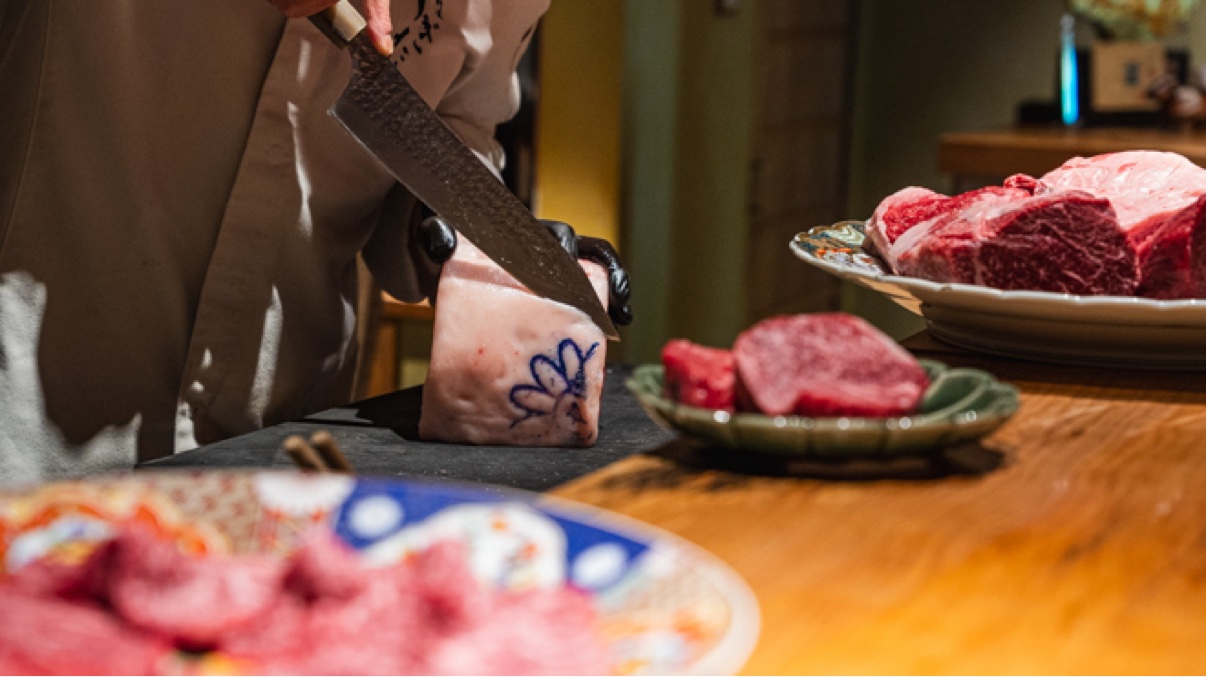
And this is not far from our counter. One of the cows we actually served at Sugitani was traced by its individual ID back to the breeding farmer where it was born. Every plate of Kobe Beef begins with someone like Mr. Nakamura, in a shed in Ojiro, deciding to keep going for one more year.
The world agricultural heritage system that protects Tajima cattle farming in the Mikata region assumes the same thing: that these small breeding farms continue. The system, the brand, and the beef all rest on farmers whose names never appear on a menu.
So the high calf price is good news and bad news at once. Good, because it means the calves are wanted. Bad, because it means there are not enough of them — and the people who make them are getting older, with no one behind them.
The next time a champion calf makes the news for its price, remember the other side of that price. Somewhere in Tajima, a farmer is doing the maths on feed, land, and the next generation — and deciding whether the pyramid holds.
A Note from Our Counter in Kobe
I write this as the chef-owner of Kobe Nikuryori Sugitani, a small restaurant in Sannomiya, Kobe. We are a designated registered restaurant of the Kobe Beef Marketing & Distribution Promotion Association — registration No. 2072 — and we serve only certified Kobe Beef, in an omakase course at a counter of just seven seats, by reservation only.
At our counter, Kobe Beef is not only a steak. Across the course, it appears in many forms — lightly seared, with seasonal ingredients and seafood, in a hand-rolled sushi with sea urchin and crab, and in a chirashi sushi that closes the meal — so that each dish shows a different side of the same beef.
If your travels bring you to Kobe, we would be glad to welcome you. Reservations can be made here.
Sources: Kobe Shimbun, 6 November 2026, “子牛高値なのに後継者足りず” (lead report); Kobe Shimbun, 5 November 2026 (survey of Tajima breeding farms); Hyogo Prefecture livestock statistics; earlier articles on this blog on Tajiri-go, Ueda Livestock and the Kobe Beef bloodline system.
Leave a Reply